
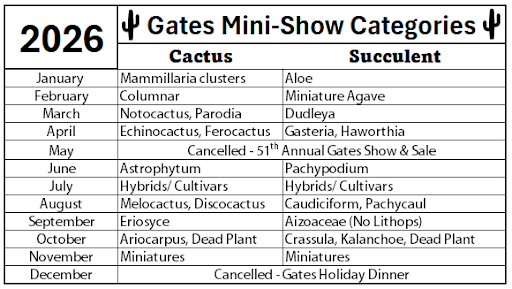
Cactus: Ariocarpus; Dead Plant
Succulent: Kalanchoe; Dead Plant
**Remember: You must be up-to-date on your membership dues to be eligible to compete in the monthly mini-show. See Phuc prior to submitting your plants to ensure you are current on membership.
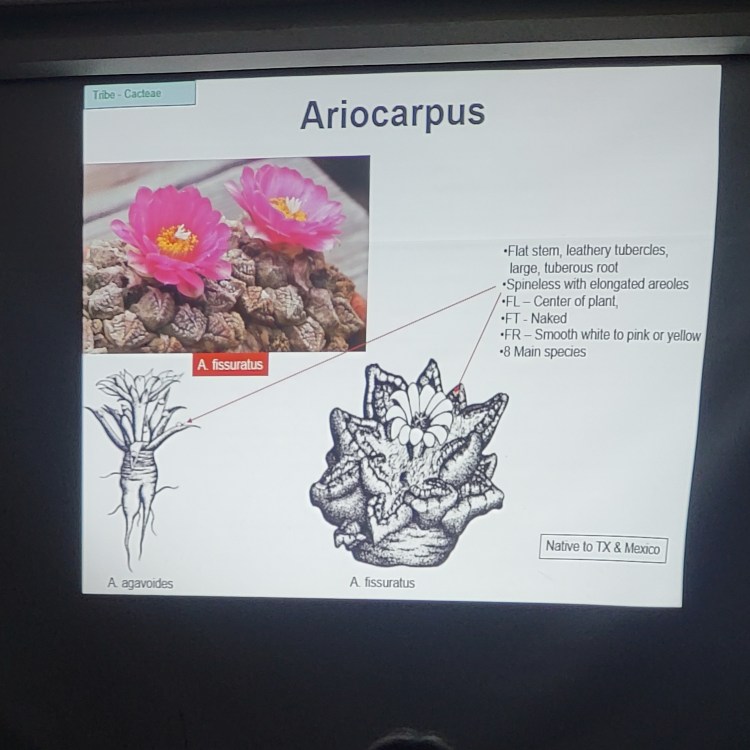
“Ariocarpus” by Tom Glavich
Ariocarpus is one of the treasures of the world of Cacti. This genus, from Central to Northern Mexico and Southern Texas has some of the most spectacular species of the entire family. Some succulent growers, who otherwise avoid cacti, make this genus their sole exception. There are collectors who collect nothing but Ariocarpus, and have hundreds of plants in their collections. Rare specimens can change hands for hundreds of dollars. Rare cultivars with unusual tubercles can be sold for even more, particularly in Japan. There is no denying that this genus has generated a worldwide cult of devotees.
With all of this, you might expect Ariocarpus to be expensive, difficult to come by, and difficult to grow. Nothing could be further from the truth. They are no more difficult to grow than any other central Mexican genera. All of the species and all of the varieties are readily available, and all are affordable. This genus is well within the range of even beginning novice growers. Field collected specimens are occasionally available, and these are much more expensive, and much harder to grow. Recently collected specimens are now almost always illegally obtained. However, interesting hybrids have been produced by several growers, Frank Nudge of our club, Miles Anderson and Gene Joseph of Tucson being just a few.
With all of the fuss we make over the horticultural merits of this genus, we shouldn’t overlook the plant which have important ethno-botanical uses from several Native American cultures. The tubercles contain sticky mucilage, and this was often used as glue to mend broken pots. A. kotschoubeyanus was boiled and used as a cure for rheumatism, and several species were used as ‘false peyote’ in religious ceremonies.
Cultivation is not difficult, when the home environment of these plants is remembered. They grow in mineral soils, with very little organic matter. They all have large tuberous roots. They grow in areas that are very hot in the summer, and that have summer rainfall. If they are protected from excess organic matter, particularly peat, and watered heavily and fertilized only in hot weather, good growth will result. They need protection from winter rains.
There are six species, several varieties, and a near infinite set of cultivars.
Ariocarpus agavoides, as its name implies “resemble agaves.” Discovered only in 1941, it is rare in nature and cultivation. It comes from just a few areas in Tamaulipas and San Luis Potosi.
Ariocarpus bravoanus has flattened triangular tubercles. A beautiful species, it is slow growing and still not seen in many collections, although seedlings are now often available. This species also comes from just a few localities in San Luis Potosi.
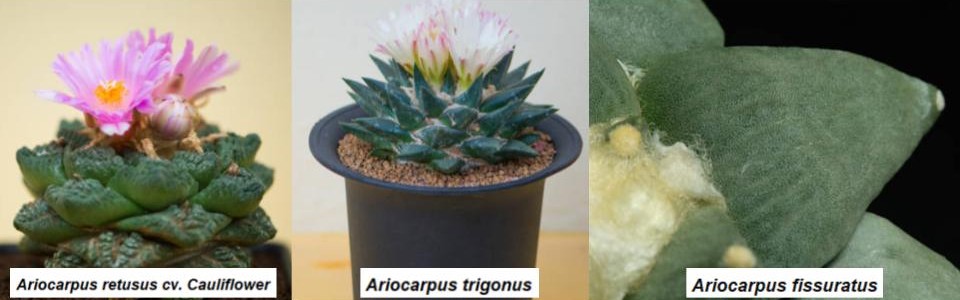
Ariocarpus fissuratus is much more common. This species spreads from the Pecos River in Texas south to Durango. The wide geographical range of this species; along with the isolation of some of the populations has given rise to several cultivars. This species is one of the more collectable, with many cultivars and hybrids with extra hair, wide tubercles, etc.
Ariocarpus kotschoubeyanus is the miniature of the genus. This species never gets above ground. It is widespread in Mexico, occurring in silt plains from Coahuila to Queretaro. In habitat, this species is sometimes under water! It is relatively easy to grow, requiring only a good, quick draining potting mix. Multiheaded specimens of this species are especially appreciated.
Ariocarpus retusus was the first species discovered, first described in 1938. This is an easily grown species. It is widespread throughout the Chihuahuan desert. A subspecies A. retusus ssp. trigonus has more triangular tubercles. As with fissuratus, there are dozens of cultivars, variants, variegates, etc. of the species and the subspecies.
Ariocarpus scaphirostris is another of the small, less collected species. Seedlings are available and it is no more difficult than many others. It is native to Nuevo Leon.
Crassula and Kalanchoe by Tom Glavich
The genus Crassula is a mostly African member of the Crassulaceae family. Crassula is distinguished from the rest of the family by having as many stamens as petals and having opposite leaves. Other African members of the Crassulaceae have twice as many stamens as petals.
The genus runs the gamut from beginner plants that are virtually indestructible to difficult winter growers that are intolerant of water in the summer, but at the same time prone to drying up if insufficient moisture isn’t provided. For the most part these plants are easy to grow, requiring only winter water and some protection from full summer sun.
Many members of the Crassula family get leggy with age and need periodic pruning and restarting. Cuttings should be taken when the plants are in active growth, early spring being best, left to dry for a day or two, and then simply potted in the same mix as the original plant. Rooting is almost always rapid and new growth appears in a week or two.
Many cultivars have been developed and are available at shows and even many local garden centers. First quality cultivars can sometimes be found at home centers.
Propagation from seed is possible, but surprisingly difficult. The tiny seeds should be planted in October or November. Germination is sporadic, and keeping the young seedlings alive is often a challenge.
Crassulas to Crave:
Crassula alstonii is a wonderful miniature species with tight hemispherical leaves piling on one another.
Crassula ausiensis from Namibia is a clumping species, one of many that closely resembles a mesemb as much as a Crassula.
Crassula barbata from South Africa, only an inch and a half when fully grown is a ciliate (hairy) rosette. It offsets as old heads die.
Crassula falcata, more often a garden subject than a pot plant, can grow to several feet high and across. It has spectacular heads of bright red flowers, often in August when this color is often missing from the succulent garden.
Crassula hemisphaerica from Namibia and South Africa, matches its name.
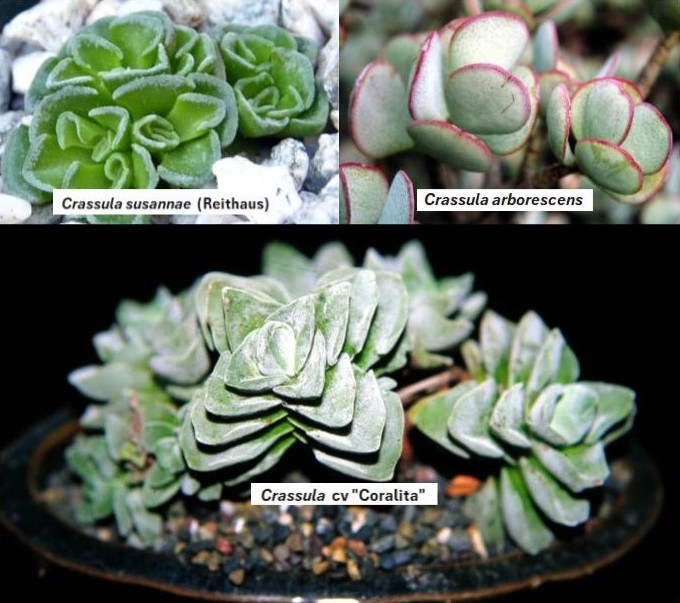
Crassula suzannae, another of the small clumping species, looks much like a mesemb, and is sensitive to watering at the wrong time of year.
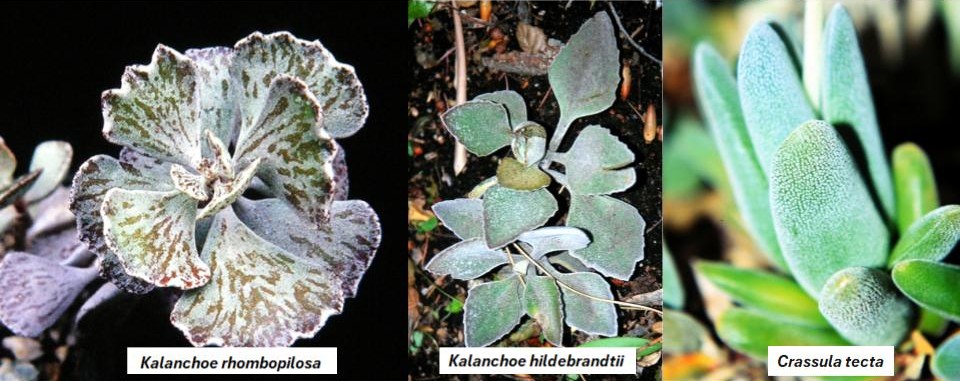
Crassula tecta has many forms and cultivars. White spotted and patterned leaves make this a choice species.
Great cultivars include:
Crassula “Tom Thumb” forms a dense mat of small leaves. The leaves color quickly with red edges setting off the green centers.
Crassula “Morgan’s Beauty” has wonderful gray leaves, with a blush of blue and pink. A classic hybrid between C. falcata and C. mesembryanthemopsis, its flowers match the beauty of the leaves.
Finally, no discussion of Crassulas would be complete without including the wonderful garden plants, Crassula arborescens, Crassula ovata, and their various cultivars and hybrids. These are easily obtained and cuttings are frequently available at the monthly meeting and workshop.
Kalanchoe is one of the main genera of leaf succulents in the Crassulaceae Family. Kalanchoe are winter growers and generally look their best in late winter and early spring. Kalanchoe is closely related to three other genera, Cotyledon, Adromischus and Tylecodon; many members of all four families were originally described as Cotyledon.
Kalanchoe is a pan tropical genus with a large number of species in Africa and Madagascar, with significant (but less well known) populations in Socotra, India, tropical Asia, Indonesia, and a few in Central America.
Kalanchoe is by far the most widely propagated and grown succulent plant in the world. It is produced by the millions as a winter houseplant all over the world. The most popular of all is Kalanchoe blossfeldiana, from a cloud forest on Mount Tsaratanana in northeastern Madagascar. Cultivars with red, yellow, orange and even purple flowers developed from this species are produced each year by vegetative propagation (usually by micropropagation or cloning) in large commercial nurseries and sold in florists, supermarkets, and garden shops.
It is virtually indestructible and grows and blooms through the winter in heated apartments, offices, etc. with little care. It eventually gets leggy and stops blooming and is generally thrown out during a spring cleaning.
Kalanchoe care in Southern California is extraordinarily easy. They tolerate light frosts and do well outside in our rains. A few of the more tropical species are sensitive to cold but most tolerate anything we get without more than a few dropped leaves. Most of the species sold in florists will do well as bedding plants in local gardens. Producing a show quality plant requires a bit more work. Pruning and pinching of growing tips to encourage side growth is required to get a full-bodied plant. Since most of the cultivated species come from the cloud forests of Madagascar, they never go through long periods of dryness and require some watering and moisture even during their summer dormant period.
Propagation is easy… take a cutting and stick it in some potting soil. Success is virtually guaranteed. There is no need to wait for the end to dry and no need for growth hormones. Leaves can also be rooted and many leaves falling from a plant will often root on the potting bench or in neighboring pots.
Seed is rarely available but is also easily grown, and sows well in the fall. Growth is fairly rapid, and flowers during the next winter can generally be expected.
Although pot grown Kalanchoe lose their bottom leaves when they are stressed for water, Kalanchoe grown in the ground do not have this problem. Much larger and better-looking plants can be grown in the ground than can ever be grown in pots. Plants grown in the ground look much more like those from habitat.
Kalanchoes to Keep:
Kalanchoe beharensis is a variable large leafed plant from Madagascar. There are several unusual shaped and colored cultivars available, including ‘Fang’ and ‘Oak Leaf’. The leaves are often felt-like, with a mixture of green and brown.
Kalanchoe fedtschenkoi is another variable species, common in the florist trade as well as succulent shows. There are many varieties and cultivars, and several interesting variegated forms as well. It has blue-purple to gray to white leaves, depending on the cultivar. It is weak stemmed, and is often grown as a sprawling or even hanging plant.
Kalanchoe rhombopilosa is a small plant, reluctant to branch, with dense beautiful gray leaves covered with red spots and lines.
Kalanchoe synsepala has great blue-green leaves with red to purple serrated edges. It produces offsets on long trailing stems. It is great as a hanging plant, or in a show pot.
Kalanchoe tomentosa is a wonderful densely leafed shrub. The leaves are green and white and feel as if covered by felt. When given enough light and water, the edges turn red or brown. It is easy to grow poorly, but very hard to grow well.
Kalanchoe uniflora is another climbing species. In spite of its name, the flowers occur in groups of three, with many groups per plant. It is naturally epiphytic, and is happiest as a hanging plant.
References:
W. Rauh, Succulent and Xerophytic Plants of Madagascar
M. Sajeva and M. Costanzo, Succulents, The Illustrated Dictionary


