
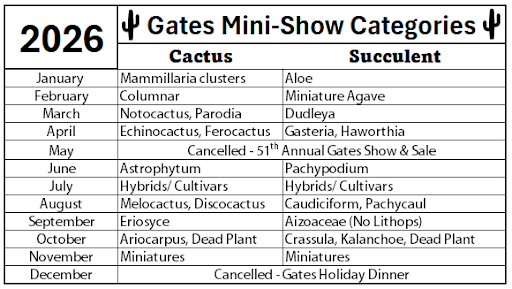
Cactus: Eriosyce
Succulent: Aizoaceae (no Lithops)
**Remember: You must be up-to-date on your membership dues to be eligible to compete in the monthly mini-show. See Phuc prior to submitting your plants to ensure you are current on membership.
Echinocactus and Ferocactus by Kyle Williams
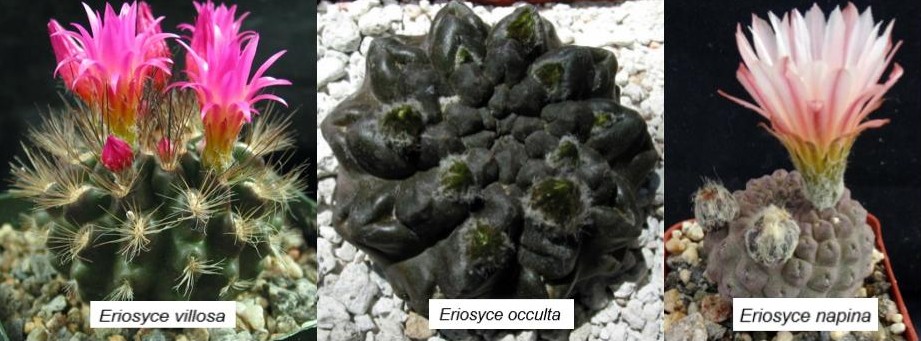
Eriosyce is a genus of cacti from Chile and parts of Peru and Argentina. They are popular among cactus enthusiasts as they are small, easy to grow and many of the species have colorful bodies and interesting spines. Most species start out globular, with some staying that way and clumping readily, while others slowly become columnar. At least one species, E. aurata, becomes large and round, somewhat similar to a Golden Barrel. The name Eriosyce means “wooly fruit”, one of the distinctive characteristics of the group. The genus in its current form is a relatively recent taxonomic change from up to eleven small genera into a single medium size genus of about 35 species. Of those many genera, Neochilenia and Neoporteria are the best known to growers.
Eriosyce is a great example of how good taxonomy can work. Professional taxonomists do not change names for the sake of change. If they make a change, it is because intensive research often spanning several years, shows that a nomenclatural change is in the best interests of science.
In this case we have lots of different genera because numerous taxonomists over the last century or so looked at these plants piecemeal, often using only dry specimens in a museum, or only seeing a small number of species in habitat. They did their best with what they had, but without the big picture it is easy to think you have something unique that deserves its own genus. Then came along a taxonomist who decided to really focus on this group and spent extensive time in the field seeing them in the wild. Once he was able to study the full range of variation within and between species it became clear to him that they really were just a single genus. Interestingly, in 2019 a different researcher did a DNA study (phylogeny) of these species and found they were all closely related and should be a single genus. The combination of field work and laboratory study necessitated the change that led to 11 different genera being combined into one, Eriosyce. A takeaway of this for the average grower is that if you have any cacti labeled as Neochilenia and Neoporteria you should change them to Eriosyce.
I discuss this not to try to turn you into a taxonomist, but to help explain why a name you are familiar with has changed. Must you follow a name change? Of course not, but don’t justify your refusal by claiming scientists just like to change names. Note that I’m referring to professional or very serious amateur taxonomists (the latter being the case for Eriosyce) that back up their claims with solid data and publish in respected journals. Bad taxonomy does exist, but it usually has telltale signs.
All of the species of Eriosyce are small enough to be potted plants, with some of the bigger ones also working as small landscape plants for a succulent garden. They take general cactus care though they can be especially sensitive to overwatering as most species have tap roots. Well-draining soil is a must. The species with colorful bodies are usually at their best in high light (protect from afternoon sun) and may turn greenish in lower light. Most species can take the occasional light frosts we get in this region.
“Aizoaceae” by Buck Hemenway
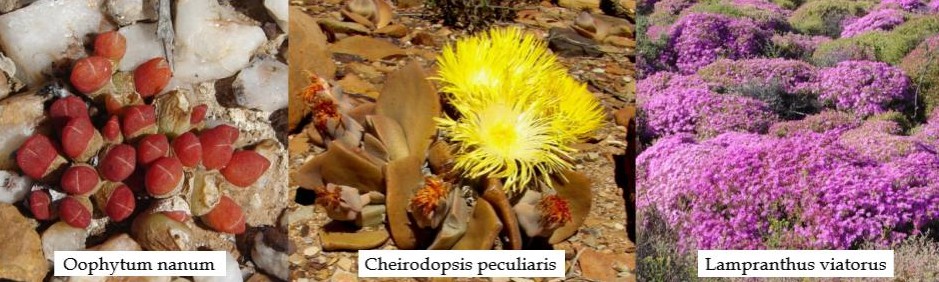
We know this plant family by many names. The newest is Aizoaceae and the most familiar are Mesembryanthema (Mesembs), Ice Plant and Vygies. There are about 150 recognized genera of succulent plants and more than 2000 species in this family. They have been categorized in many ways by as many authors who have published books on them.
For our Mini-Show, all Aizoaceae (Mesembs) are welcome except Lithops, which we usually keep for a separate show.
By far the majority of these plants are native to South Africa. It can be completely overwhelming for the succulent enthusiast to be plunked down on a roadside among 10 to 20 varieties of Mesembs, most of which one can only guess the identity of. From the diminutive Oophytum to the larger woody stemmed shrubs of the Ruschia and Lampranthus genera, the variety and scope of this family is truly amazing.
Most of the family are perennial plants that survive in unbelievable conditions. Just a few weeks of rain per year provide enough for them to survive. We need to know a little about how they survive in their native habitats in order to successfully grow them in our collections.
For the most part, the plants of this family are quite easy to grow. Their habitats are very similar to our Southern California. We tend to be hotter and a little colder than most appreciate, but we can find ways to mitigate those differences. The real key is water. Remember that most of them survive on rainfall that happens in a very short time frame and as such cannot stand to be watered when they are not ready for it.
Many of the genera are separated by their seed capsules which are pure natures genius.


