
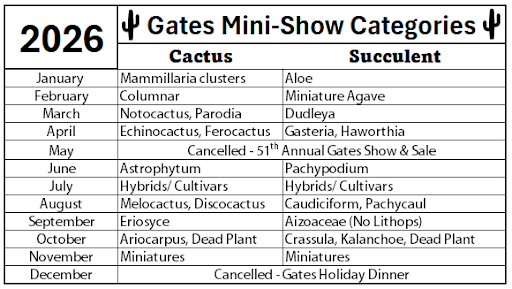
Cactus: Hybrids/Cultivars
Succulent: Hybrids/Cultivars
**Remember: You must be up-to-date on your membership dues to be eligible to compete in the monthly mini-show. See Phuc prior to submitting your plants to ensure you are current on membership.
Cactus and Succulent: “Hybrids and Cultivars”
Article by Tom Glavich
Hybrids
Hybrids are the offspring of two plants of different species. Examples of hybrids are the many Madagascar Aloes currently available such as Aloe “Lizard Lips,” Aloe “” etc. Other popular hybrids are the Dyckia hybrids created by Bill Baker and many others. Dyckia “Keswick,” Dyckia “Brittle Star,” and Dyckia “Turbo” are all hybrids. Nearly all the common houseplants sold at big box nurseries are hybrids.
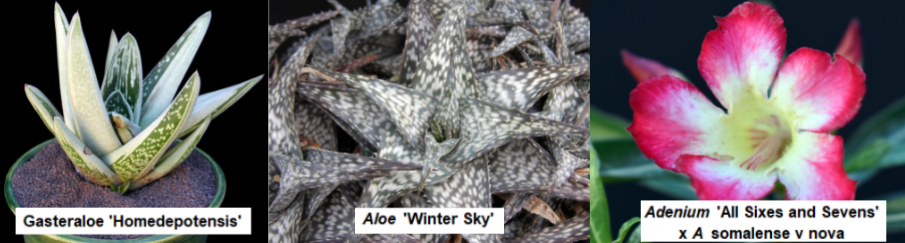
Generally, both plants are in the same genus, but not always. Dyckohnia “Conrad Martin” is a bi- generic hybrid between Dyckia macedoi and Deuterocohnica meziana. All of the “Gasteraloes” (Gasteria and Aloe hybrid) such as Gasteraloe “Royal Highness” are also intergeneric hybrids. Intergeneric hybrids are much rarer in cacti, but “Ferobergia” is a hybrid between Ferocactus and Leuchtenbergia. Recent work by several California growers is beginning to show promise with intergeneric cacti hybrids, only thriving if kept above 50 degrees. P. lamerei is the biggest exception in that it is a Madagascar species that can tolerate the occasional light frost in our region.
Cultivars
Cultivars are plants that are generally vegetatively propagated, and that share some unique trait that make them different from others of the same species. Cultivars include Copiapoa hypogea “Lizard Skin” and many of the Haworthia hybrids available.
Cultivars can be either a species or a hybrid. When sufficiently isolated and self propagated for several generations, cultivars can also be propagated by seed. Lithops “Jackson’s Jade,” named for California propagator and Mesemb expert Tim Jackson, Lithops optica rubra reproduce fairly reliably from seed.
Hybrids of many species are easy to produce. Bees and hummingbirds will do all the heavy work of transferring pollen from one plant to another. You need to ensure there are only two plants in flower in their reach (harder than it sounds). When the fruit is ripe, the seeds are collected and stored until planting time. Planting in either the spring or fall will generally give best results.


