
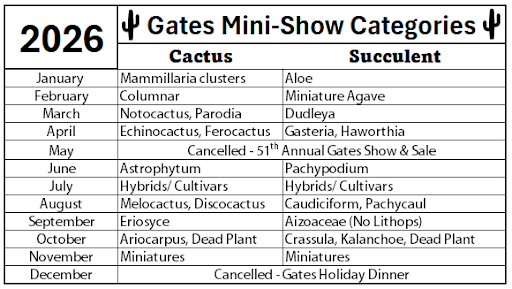
Cactus: Astrophytum
Succulent: Pachypodium
**Remember: You must be up-to-date on your membership dues to be eligible to compete in the monthly mini-show. See Phuc prior to submitting your plants to ensure you are current on membership.
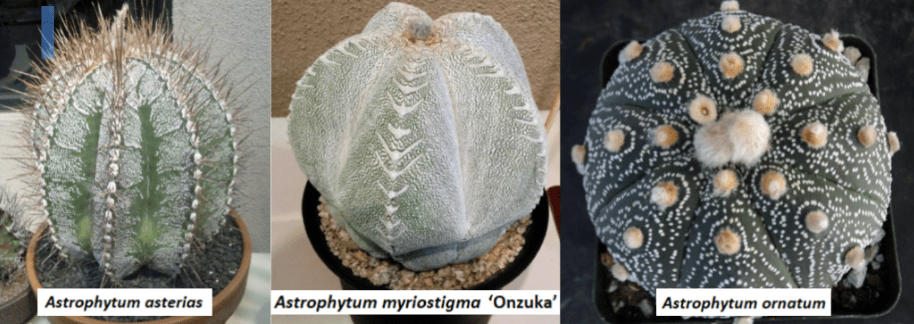
Echinocactus and Ferocactus’ by Kyle Williams
(Photos by Kyle Williams, Heath MacAllister, & ShineB)
‘Astrophytum’ by Kyle Williams
Cactus Astrophytum are often one of the first cacti that a novice cactus grower buys, yet a well grown, mature specimen will impress even the most experienced collector. There are a small number of species in the genus, but numerous cultivars of those species give the serious collector new plants to add to their wish list all the time.
Astrophytum contains 5-6 species that are native to Northern to Central Mexico, with one species (A. asterias) extending into the Big Bend region of Southern Texas. Four species, A. asterias, A. capricorne, A. myriostigma, and A. ornatum are very common in cultivation and can often be seen for sale at local nurseries and big box stores. Another species, A. coahuilense, is not recognized as a species by everyone because the plant looks nearly identical to A. myriostigma. However, the flowers are different (A. coahuilense has a red throat while A. myriostigma does not) and crosses between the two are extremely difficult to make due to a high degree of sterility. Plants of the same species should cross easily, which they do not.The most unusual species of Astrophytum by far is A. caput-medusae. Described only in 2001, this species has numerous long, thin, tubercles that look like arms emanating from a central point. Another interpretation of its appearance is that it looks like a bunch of snakes. In fact, the Latin name “caput-medusae” means “Medusa head” which is a very apt description! This is so completely unlike the rest of the genus that the first taxonomist to name it called it Digitostigma caput-medusae, believing it to be a brand-new genus. However, once you get past the bizarre shape of the plant you start to notice the arms are covered in soft white scales or hairs just like the rest of Astrophytum. When the plant blooms the flower is indistinguishable from other Astrophytum, and the seeds are identical to those of that genus.
Astrophytum grows in very arid regions, with porous mineral soils. Their adaptation to this environment can lead to cultivation difficulties as they have a tendency to split open from sudden increases in soil moisture level. To avoid this, keep them in soil that is very quick to drain, and which has little organic matter. A mixture of pumice and gravel or very coarse sand, with only a little potting soil is best for these plants. The roots are designed to pump up as much moisture as possible in as short a time as possible from infrequent rains. In a slow draining potting mix, they will do this very effectively, and the body of the plant will swell, but the skin will not. Eventually the body pressure gets too great and the skin cracks. Despite this, most species will grow well under normal cactus culture. One notable exception is A. asterias. This species is extremely rot prone when overwatered or watered at the wrong time. It comes from a region with essentially no winter rainfall. Rain is concentrated in the summer months (just the opposite of us in California).
Growers in Japan and more recently in Thailand have developed some spectacular clones, cultivars and hybrids, particularly with A. asterias and A. myriostigma. The most popular cultivars of A. asterias are sold under the name of Astrophytum “Super Kabuto” and Astrophytum “Miracle Kabuto.” Some of these special clones with intricate patterns can sell for hundreds of dollars when first developed. After a few years of propagation, the price drops to levels that most can afford.
‘Pachypodium’ by Kyle Williams
When most people think of Pachypodium they think of Madagascar for good reason. Of the 30 plus species known to science, all but 5 come from there. The rest come from Southern Africa. Some species look like true desert dwellers like P. namaquanum, others look like they are from tropical rainforests, but are actually from tropical dry forests, like P. lamerei. Yet others, most notably P. brevicaule, look like they could come from an alien world!
That means every species you see comes from Madagascar, except: P. namaquanum, P. succulentum (including P. griquense), P. bispinosum, P. saundersii, and P. lealii. Interestingly, these African plants tend to be a bit easier to grow on the whole, possibly due in part to more tolerance of our cool winters. Madagascar by contrast is a more tropical island with uniformly warm temperatures, even in the driest regions.
Pachypodium belongs to the Apocynaceae, one of the largest of all plant families as well as one of the families with the most species of succulents. It is closely related to Adenium, Stapeliads, Fockea, Oleanders, Milkweeds, Plumeria, and many other non-xeric plants. While most similar to Adenium, Pachypodium can be distinguished from it by having spines, and usually by flower color. While pinks and reds are extremely common in Adenium, only a few Pachypodium have red or pink in their flowers. Pachypodium also stands out from most of the family, including Adenium, in having alternate leaves (one leaf at each node) while the rest of the family (usually) has opposite leaves (paired leaves).Have you ever given thought to how plants end up where they are and why some places have more species than others? The distribution of Pachypodium may lead you to consider that. Why are there so many more (4-5x) as many species in Madagascar than in the whole of continental Africa? It must be because Pachypodium evolved in Madagascar, right? Possibly, but it is equally likely that it evolved in Africa but didn’t diversify greatly there, but when a single plant arrived in Madagascar it rapidly spread around the island then became isolated in different habitats which over time evolved into different species. In other words, a center of diversity for a plant group today doesn’t necessarily mean that’s where the group originated. In one location the conditions may have allowed for tall, tree-like, species to form (e.g. P. lamerei and P. geayi) while in other places, such as very dry rocky hills, small very xeric species may have been better adapted. Yes, Africa also has lots of different habitats, but it may have had to compete with many other plants already there while
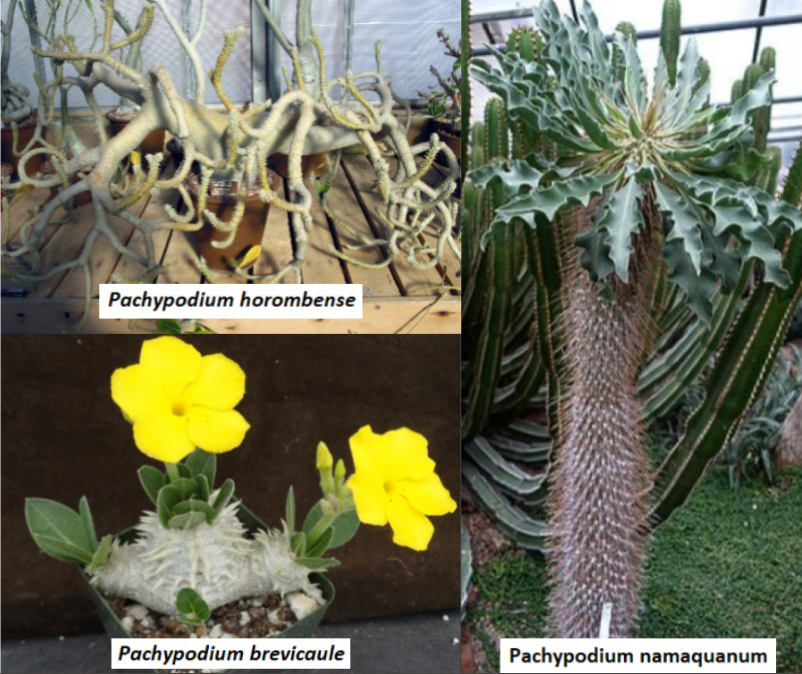
Madagascar might have had less plants at the time, making it easier for Pachypodium to thrive and diversify. Recent research into the relationships of Pachypodium suggests this may well be what happened!
Cultivation of Pachypodium is generally easy. Most like constant moisture (not wet though!) during the growing season. When they drop their leaves in the winter, keep them dry. Some species, like P. brevicaule, are more water sensitive than others. The biggest difference between African and Madagascar species is in cold tolerance. In general, African species can tolerate colder conditions, while Madagascar species need to at least be kept above freezing, with some species only thriving if kept above 50 degrees. P. lamerei is the biggest exception in that it is a Madagascar species that can tolerate the occasional light frost in our region.


