
By Buck Hemenway
Remember: You must be up-to-date on your membership dues to be eligible to
compete in the monthly mini-show. See Jeff prior to submitting your plants to ensure
you are current on membership.
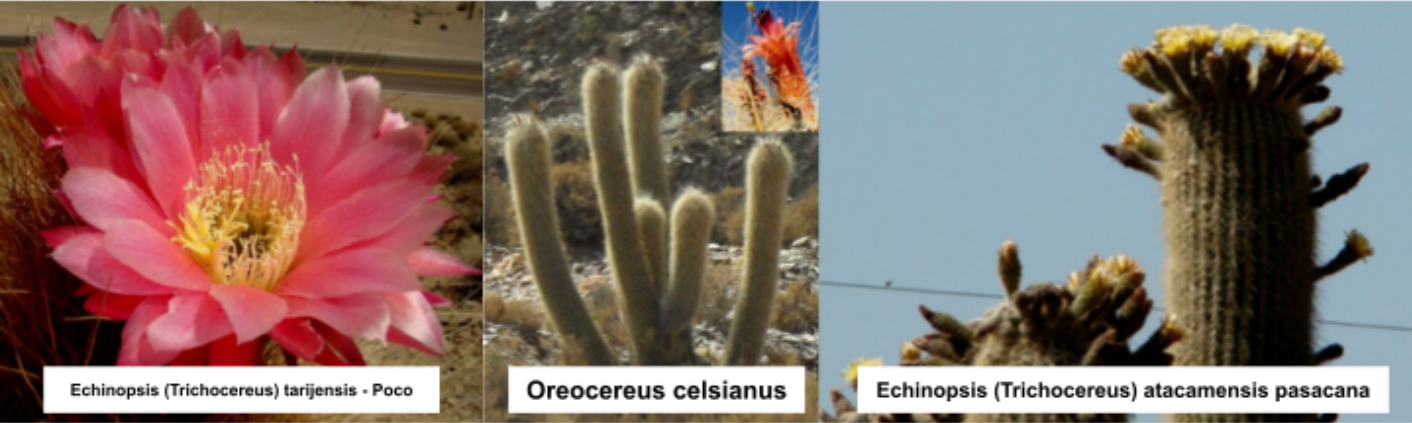
Otherwise known as the Giants of the Andes, many of them are among the largest cacti on earth, rivaling the North American Saguaro (Carnegia gigantea) and Cardon (Pachycereus pringlei). We include all of the upright columnar shaped cacti in this group, whether they end up being huge or not. Genera such as Cleistocactus are included, just because they tend to grow in a columnar way. We do not include the ball shaped Echinopsis, but we do include all of the newly introduced Echinopsis from the Trichocereus genus that was subsumed recently. We will accept the old or the new names for these plants. Following are the genera from which these plants come: Armatocereus, Arrojadoa, Arthrocereus, Brasilicereus, Browningia, Calymmanthium, Castellanosia, Cereus, Cipocereus, Cleistocactus, Coleocephalocereus, Corryocactus, Echinopsis, Espostoa, Espostoopsis, Eulichnia, Facheiroa, Haageocereus, Harrisia, Jasminocereus, Lasiocereus, Micranthocereus, Neoraimondia, Oreocereus, Pierrebraunia, Pilosocereus, Praecereus, Stetsonia, Stephanocereus, Strophocactus, and Weberbauerocereus.
Many of these plants have enormous flowers that match the stature of the plant. Most are extremely easy to grow. All they require in our area is good drainage and they can become huge in no-time. A little care needs to be taken when selecting a South American plant for your landscape. Even though they may grow at above 15,000 feet in the Andes, some are very sensitive to freezing. The closer to the equator that any plant grows, the more tropical it is and as such will have little or no tolerance for freezing temperatures. A little research will reveal which plants are more adaptable to colder temperatures.
Insect pests are sometimes present and can be cared for as with any cactus plant. Any good succulent landscape should have at least one of the large Echinopsis (Trichocereus) in it. The large white flowers of Echinopsis terscheckii in late spring are iconic in their symbolism of what a cactus flower should look like.

 Gates Cactus and Succulent Society