
By Kyle Williams; photos by Kyle Williams, Frank Vincentz, and Paul Kaluschke
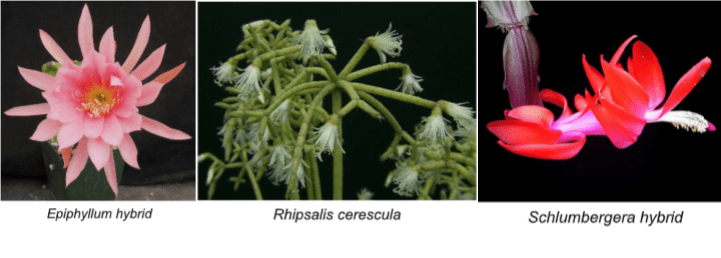
When you think of a cactus in the wild you probably imagine a big Saguaro, a stunning red Ferocactus, or a cute little Mammillaria growing in a vast sandy desert. Sure, most cacti are ground dwelling arid climate plants but did you realize some cacti grow on tree branches in rainforests? They do and they are the ones we’ll be looking at this month. The genera we are covering include Rhipsalis, Schlumbergera, Epiphyllum, Hattoria, Disocactus, Lepismium, Selenicereus, Hylocereus and Weberocereus (and possibly others).
An epiphyte is any non-parasitic plant that grows on trees or other structures without soil. Orchids and Bromeliads are the most famous epiphytes, but ferns, mosses, and yes even cacti can be epiphytes too. The idea of a cactus living on trees in the jungle isn’t as big of a stretch from a desert cactus as you may think. A desert cactus has adapted to survive the extreme drought of its native habitat by developing fleshy stems to store water and a root system used to drying out but rapidly up taking water on the rare occasions that rain falls. It may rain a lot in the rainforest, but periods of days or weeks without rain are common. It may be often enough for the soil to stay moist, but a tree branch will dry out within hours. To live on a tree where there is no soil, maybe a bit of leaf debris and moss at most, a plant needs to withstand these dry periods. A plant with the ability to store water in its stems and rapidly uptake water through the roots has a definite advantage in this environment. When looked at from that perspective it starts to become clear that a plant growing in the desert and one growing on a tree have remarkably similar habitats to deal with.
While there are definite similarities between an epiphytic lifestyle and life in the ground in the desert, there are some big differences as well. While a rainforest epiphyte may go days to weeks without water, it rarely has to deal with drought periods as long as a desert cactus does. Reflecting this, most epiphytic cacti stems aren’t as thick and fleshy as a typical desert cactus. Additionally, epiphytic cacti are more shade tolerant than desert cacti, and in fact are much more prone to sunburn than a standard cactus. This makes sense when you think about where epiphytic cacti are growing, on a branch on a tree shaded by all the leaves of the tree.
Many epiphytic cacti like Rhipsalis and Schlumbergera grow in a jointed fashion, the latter also having flattened segments giving the appearance of being leaves. These are stems despite the leaf like appearance. Another growth form is seen in Epiphyllum. They also have flattened leaf like stems but grow in long continuous stems instead of numerous short joints. The flowers of epiphytic cacti have a very large variation in size, color and shape. Rhipsalis have some of the smallest flowers among cacti and are usually small and white. At the other end of the spectrum, Epiphyllum and intergeneric hybrids that include Epiphyllum can have flowers 6” across and come in virtually every color except blue. In between are Schlumbergera species and hybrids which have colorful tubular flowers that are 2-3” long. These are better known as the Christmas or Thanksgiving Cactus, quite possibly the most widely grown cactus in the world.
To many cactus and succulent growers, Sansevieria is something of an oddball group that gets thought of more as a houseplant than a real succulent. While it makes a great houseplant, it is an unfortunate way to look at this interesting genus of plants. I like to think of them as one of the very few groups of succulents that can tolerate, and even thrive in low light situations such as life inside a home. While most species can do well indoors, that is by no means the required or preferred way to grow them. In our mild climate they can grow outdoors year-round and make a great addition to the shadier spots of your landscape. They are among the easiest to grow and most tolerant of abuse of all succulents.
Sansevieria is a genus of approximately 70 species in the Asparagus family (Asparagaceae). Most species occur in Africa though some species have found their way to India and even Myanmar (Burma). The most notable differences between species are the length and shape of the leaves, as well as the coloration and patterning of the leaves. The common names “Snake Plant” and “Mother in law’s Tongue” come from the long, stiff, pointed, and mottled leaf appearance of the most commonly grown species. However, some species produce much more interesting and unique leaf shapes. In particular, species such as S. cylindrica have leaves that are nearly circular in cross section. It is important to note that many taxonomists now consider Sansevieria to be part of Dracena, a genus well known for tropical houseplants and or the Dragon Tree, Dracena draco. For simplicities sake well will consider Sansevieria to be a separate genus for purposes of plant of the month.

In cultivation, many interesting hybrids and cultivars have been produced. Sansevieria hallii has several cultivars which carry variations on the “Baseball Bat.” The name really is fitting as the leaves are very thick and tough. One of the most attractive species is S. kirkii. It has wavy leaves that are produced horizontally or at least low to the ground. The species has a brown to bronze cast which has been the basis for hybridization and cultivar selection. Cultivars such as “Coppertone” with its rich bronze and pinkish brown coloration, really show how beautiful the coloring of a Sansevieria can be.
Among the most popular types of Sansevieria are variegates. Most everyone has seen S. trifasciata ‘Laurentii’; even if you don’t know it by name. It has long upright leaves with a yellow margin. It is not only one of the most popular Sansevieria, it is among the most popular of all houseplants. However, that is the tip of the iceberg. Variegates of S. pinguicula, S. robusta, S. kirkii and others can sell for $100 or more! For those looking beyond the typical yellow variegation, “Silver Streak”; and “Siam Silver”; are great plants with silvery- white variegation.
In recent years “miniature” Sansevieria have become popular. They tend to have rounder leaves which only get a few inches long and look great in small pots. Unfortunately, most of these “miniatures”; are actually the juvenile forms of full-sized species. Not only is the adult bigger, but it looks like a completely different plant. Sansevieria pinguicula and S. eilensis are examples of this. One of the only “miniature” species I am aware of that stays small and retains much of its juvenile look into adulthood is S. rorida.
Cultivation of most species is quite easy. They thrive in most any well drained potting mix. Outdoors they can grow in similar light conditions as Gasteria and Haworthia (bright shade, maybe some morning sun) or even shadier spots. They do well in ground, though they don’t like being in a cold and wet for excessive periods. Propagation is simple. Either divide a large plant or grow new plants from leaf cuttings. Do note that leaf cuttings of variegated plants virtually always produce regular, non-variegated plants.

 Gates Cactus and Succulent Society