
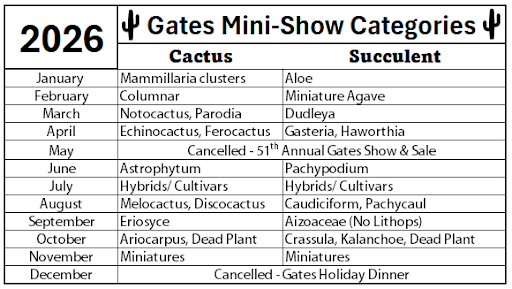
Cactus: Echinocactus; Ferocactus
Succulent: Gasteria; Haworthia
**Remember: You must be up-to-date on your membership dues to be eligible to compete in the monthly mini-show. See Phuc prior to submitting your plants to ensure you are current on membership.
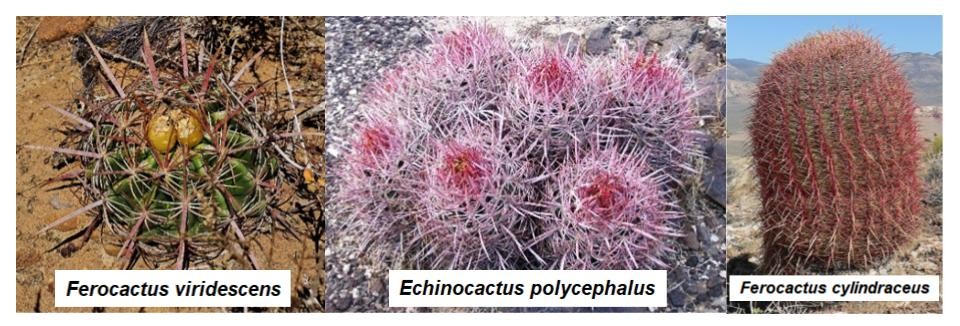
Echinocactus and Ferocactus’ by Kyle Williams
(Photos by Kyle Williams, Heath MacAllister, & ShineB)
This month we are taking on two genera of cacti with names that say “stay away!”, though I suggest just the opposite. The real reason we are talking about these genera is that they are very closely related, and together they make up the vast majority of what we refer to as “barrel cacti”. The only significant difference between the genera is the Echinocactus has wooly fruit while Ferocactus does not. In addition, they both have representatives that you can see growing wild within a couple hour drive from Los Angeles.
Echinocactus is Latin for “spiny” cactus or “hedgehog” cactus, both of which refer to the prominent, very sharp spines found in every species. The genus has roughly 6-10 species in a range that covers the Southwestern US from Death Valley to Oklahoma and Texas, as well as the Sonoran and Chihuahuan deserts of Mexico. There are two species native to the US, one covering the western half of the Southwest and the other covering the eastern half. E. texensis, commonly called the Horse Crippler, is from Texas, New Mexico, eastern Arizona, Oklahoma, and northern Mexico. E. polycephalus is a California native, as well as occurring in Nevada, Arizona, and northern Mexico. It is among the most heavily cloaked in spines of any cactus.The most famous and widely grown species, E. grusonii (Golden Barrel), is also the rarest and most restricted in the wild. There is a link between the two as large numbers of Golden Barrels were dug out of the wild for the horticultural trade. Thankfully large nursery grown specimens are readily available today, reducing the pressure on the remaining plants. Unfortunately, this already threatened species was dealt a more serious blow in the 1990’s when the Zimapan Dam was built in the heart of this species range.
Countless plants were destroyed when the lake created by the dam submerged prime E. grusonii habitat.
Ferocactus with about 30 species is the better known and more commonly grown genus of the two (excluding E. grusonii). The name means “fierce” cactus, a clear reference to the large, curved spines common throughout the genus. It has a similar range to Echinocactus, mostly differing in extending all the way to the California coast and into Baja California. Two species are native to California. F. cylindraceus, with bright red spines, is found in our desert regions while F. viridescens, a fairly small plant, can be found in coastal San Diego County. The greatest diversity in the genus can be found in Baja, as at least 10 species are found there.Cultural requirements are similar for both genera. While some species are extremely cold tolerant (i.e. the native US species) and others less so, all species of Ferocactus and Echinocactus can handle winter temperatures in the Los Angeles region. They do well in the ground, though good drainage is a must as most species do not like our wet winters. They also do well as large potted specimens, requiring normal cactus care.
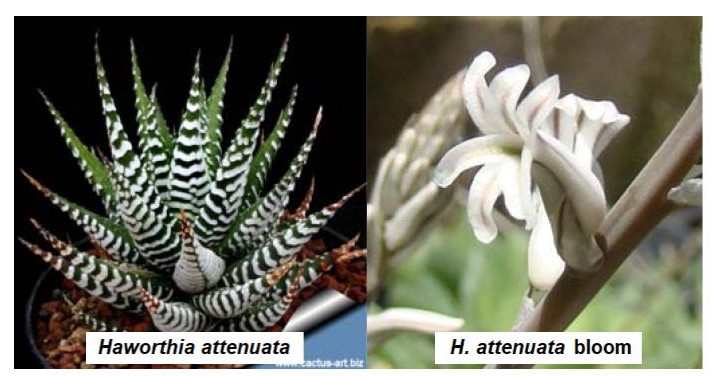
Haworthia and Gasteria’ by Buck Hemenway
These two genera are closely related and likewise related to Aloe plants, all in the family Aloaceae. They are among the most easily grown succulents. Their structural forms make them prize possessions for the beginner and master collector alike. Both genera are found in South Africa exclusively. They grow in the driest parts of the winter rainfall areas to coastal areas of the eastern part of the cape which receive fairly large amounts of summer rain.
In general, we consider both genera to be winter growers. They certainly look their best in our cooler, more wet season, but that is not necessarily true in habitat. Most of them bloom in the winter as well.
They are all relatively pest free, but will attract mealy bugs in a collection. The bugs are not difficult to control, but should be watched for.
Both genera are well studied by a number of modern botanists and with the advent of DNA testing the names and identities of many have been clouded to say the least. In addition, they tend to hybridize readily and as a result the plants that we grow are in the main not true species. The newest Haworthia text is Bruce Bayer’s Haworthia Revisited published in 1999 and we are waiting for a new book from Ernst Van Jaarsveld on the Gasteria genus.The modern way of looking at a species of a genus is to look at the plant and how it changes over its range. This viewpoint has thrown Haworthia names into a mess. It will be some time before the botanists will agree on the names in this genus.
Haworthia
The plants are generally small with rosettes of stiff leaves in many colors. They tend to be divided between ones with a “retuse” shape, like your thumb extended with the pad becoming the window through which the plant takes sun nourishment. The others have pointy leaves or truncated leaves. All of them have very similar flowers and this is what distinguishes this genus from the others in Aloaceae.
Gasteria
The plants in this genus are easily recognizable by the flowers born on long inflorescences. The flowers look like little stomachs and thus the name.
The plants range in size from small (less than 2” across) to large (more than 4’) with stiff leaves in many colors. In most of the species, the plants begin life with the leaves growing in one rank, known as distichous. Some continue to grow that way while others form rosettes.
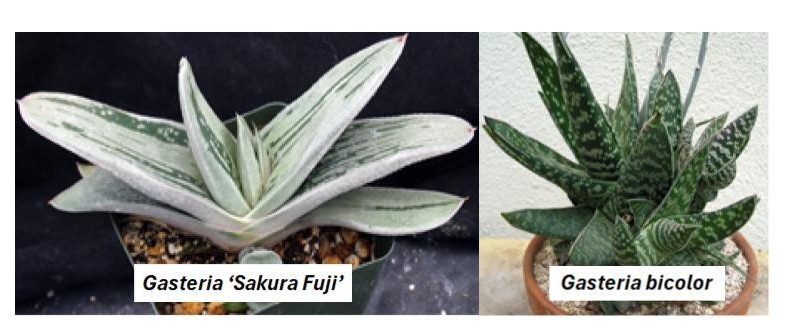
‘Gasteria’ by Kyle Williams
Gasteria is a popular and easily grown genus that has been collected since the 17th century. Some species look very similar to Aloe while others resemble Haworthia. This is not surprising as these three genera are very closely related. So close in fact that recent evolutionary studies are causing some confusion about where one genus ends and the other begins.
That said, Gasteria can be differentiated morphologically from Aloe and Haworthia by examining the flowers. Gasteria flowers have a distinctive narrow upper portion that expands out to a fat base that resembles a stomach. Sure enough, Gasteria is derived from “gaster” which means “stomach” in Latin. Interestingly the common name for the species is Ox Tongue, another “digestive” reference!Gasteria come in a much greater diversity of sizes than Haworthia, though they are smaller on average than most Aloe. Gasteria ranges in size from about an inch to several feet in diameter. Almost all plants start out with the leaves in two rows (distichous), although most eventually begin to spiral.
Gasteria are quite variable in appearance. Collectors need to be cautioned that they have definite juvenile and adult forms, have local variations in appearance, and have form and growth habits that are dependent on the soil type and amount of sunlight. Not realizing this runs you the risk of buying the same species twice!
This genus contains approximately 20-25 species, nearly all native to South Africa (one species ranges into Namibia). Typical natural habitats are humus rich, sandy soils. They grow on dry rocky hillsides and generally grow under larger shrubs particularly when young. They also can be found in rock fissures or in the shade of large rocks. The roots are shallow and thick which helps the plants obtain moisture from barely wet soils, and nourishment from decaying leaves and debris from larger shrubs.
Gasteria cultivation is easy and is nearly identical to that of Haworthia and winter growing Aloe. They are mostly winter and spring growers, but exhibit some growth all year except for the hottest part of the summer. They do well in a range of soil mixes and are more tolerant of organic matter than some succulents. They prefer partial shade, particularly in the afternoon. However, the best color is obtained by giving them as much light and sun, short of sunburn, as possible.
Gasteria are generally free from most pests. The one difficulty is ‘black spot’, a fungus that attacks many Gasteria. The fungus is rarely fatal, but causes large unsightly black spots on the leaves. Since the spots are actual damage to the leaves, there is no way to remove the spots. The fungus can be minimized by keeping the leaves dry, and particularly keeping dew off the leaves. Fungicides can be used to prevent this disease, but probably aren’t worth the hassle unless you have show quality plants you are concerned about.Gasteria are readily propagated from offsets at the base or on flower stalks, which can be simply pulled off and planted. Leaf cuttings will also root easily. Gasteria flowers are often visited by hummingbirds, and these visits often result in pollination. Seed can be collected as soon as the fruits start to dry. Cross-pollination can produce interesting plants and many hybrids are available, as are several variegated cultivars. Intergeneric hybrids with Aloe (called X Gasteraloe) and Haworthia (X Gasterhaworthia) are commonly seen.

 Gates Cactus and Succulent Society