
Cactus: Columnar Cacti
Succulent: Miniature Agave
**Remember: You must be up-to-date on your membership dues to be eligible to compete in the monthly mini-show. See Jeff prior to submitting your plants to ensure you are current on membership.
‘Columnar Cacti’ by Kyle Williams
(Photos by Kyle Williams, Ken Lund, Frank Vincentz, Raffi Koijan, & Bernard Gagnon)
Columnar cacti are a highly heterogeneous group defined by growth form rather than any natural grouping or relationship. As such, there is very little that unifies the group outside of growth form, which can roughly be defined as an upright, mostly self supporting, cactus that is at least 3-4x’s as tall as wide. Implied in this definition is that the “column” is largely unjointed, thereby excluding cacti such as Opuntia and Schlumbergera. Even so, we are left with a vast array of cacti that are anywhere from a few inches to over 50 feet tall, ranging from the United States all the way down to southern South America, with cold tolerance ranging from highly frost sensitive to those that can be frozen solid for the winter without harm. To add confusion to the mix, some species start out as globular but after many years become columnar. For example, Astrophytum species are usually seen in shows as globular, or short columnar plants at most. However, at the Huntington Garden you can see examples of Astrophytum in the ground that are several feet tall!
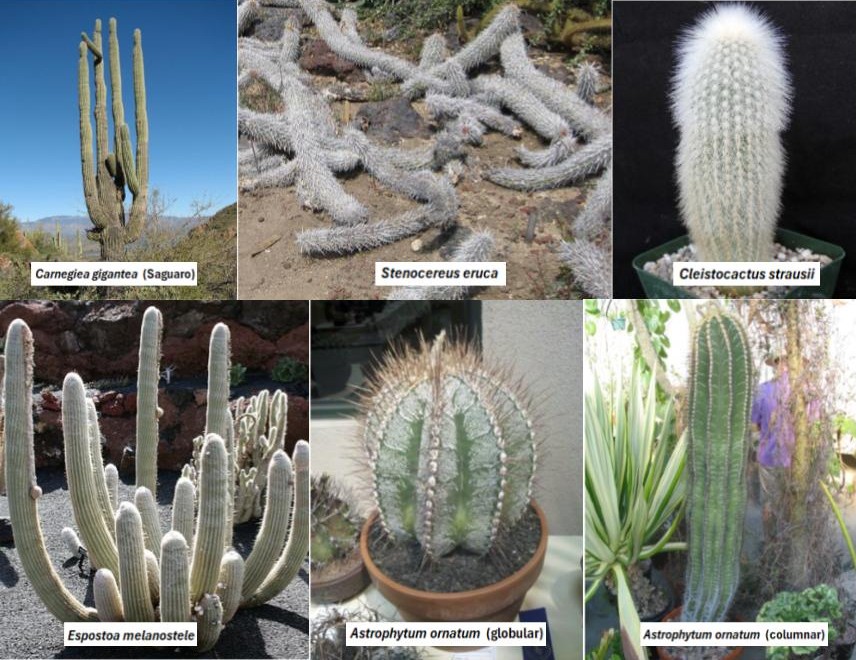
There is at least one other rule of thumb that can help you decide if you have a columnar cactus. Does it have “cereus” as part of the name, the genus in particular? If yes, then it counts as columnar. Cereus was the genus for all columnar cacti at one point. It has since been broken up into multiple different genera, but many of them retain “cereus” in their names. To be clear, all “cereus” count as columnar, but plenty of non-cereus are also columnar (like Saguaro, Carnegiea gigantea). So size and shape are still very important. So what can we say about them? As a rule, they tend to grow faster than globular cacti. They also are more tolerant of full sun, as the nature of their growth means they don’t stay shaded by shrubs and grasses, unlike their more diminutive counterparts. Larger species will eventually need to be put in the ground. Smaller types (like many Mammillaria) make wonderful specimen plants in pots for years on end. Some of the taller types may require some staking in windy climates to avoid the risk of snapping in a windstorm. When choosing a place to plant them it is important to know if the cactus stays fairly upright and unbranched or if it sends out multiple stems and branches turning into a giant shrub of sorts. Knowledge of growth rate is also key, as many species can reach 15 feet in a few years, while a Saguaro may take your entire lifetime to reach that height! With such variation between species it is paramount that you look up the specific requirements of the plants you choose.
‘Miniature Agave’ by Buck Hemenway
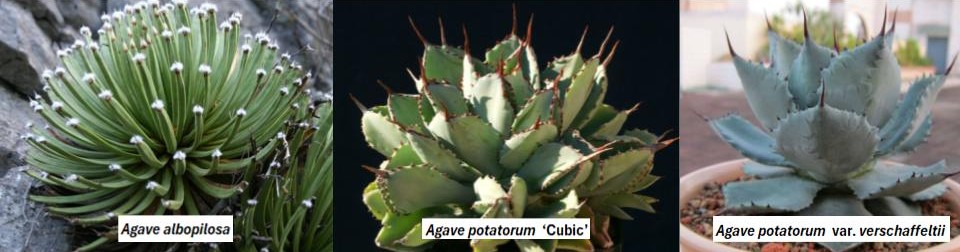
Agave is a large genus of succulents with leaves. They range in size from miniature plants such as A. minibell to giants like A. americana and A. salmiana which have rosettes that are nearly 15 feet across.
This month, we are focusing on the small agaves. Show plants will be those whose mature growth is no more than 15” across the rosette.
There are several ways to identify an Agave:
- Their leaves are always tipped with a terminal spine. Even the soft tipped A. attenuata, has an obvious terminal spine.
- The leaves are formed in a tightly wrapped bud. There is so much pressure in the bud that those leaves with “teeth” leave permanent “bud imprints” on the leaves fronts and backs.
- Leaves tend to be fairly rigid and grow in rosette form.
Agaves are “moncarpic” which means that they have only one life cycle. No matter how long it takes for the plant to produce it, the bloom stalk is a terminal inflorescence. That means that the plant dies after blooming. The bloom stalk can be produced from 7 years to 40 years of life depending on conditions and the variety of the plant.
Agaves grow in the Southwest US and on some Caribbean Islands, south through Mexico. They were an important resource for all people who lived on the land throughout history. The extremely fibrous leaves with the very sharp terminal spines have always been used to sew or bind other materials together. Their roots make good soap. They all will produce a fermented beverage that was used throughout their range. We are most used to Tequila which is derived from the Agave tequilana in the state of Jalisco. Some, such as Agave americana, are cold hardy to below 0 deg F. Depending on the variety, they tend to offset and form large clumps of plant material. It is important to know which you are planting and how it normally grows. Most will take full sun and heat, as well as cold and are extremely easy to grow.
There is no more dramatic landscape plant than a large Agave. It can become the key to an attractive succulent landscape. The inflorescence is truly a wonder of nature. The energy used to create those 25-foot-tall trees in just a few weeks is amazing.Examples of miniature Agaves: applanata, isthmensis, Victoriae Reginae, macroacantha, parviflora, toumeyana, polianthiflora, utahensis.

 Gates Cactus and Succulent Society