
Cactus: Schlumbergera
Succulent: “Trailing” Senecios
**Remember: You must be up-to-date on your membership dues to be eligible to compete in the monthly mini-show. See Jeff prior to submitting your plants to ensure you are current on membership.
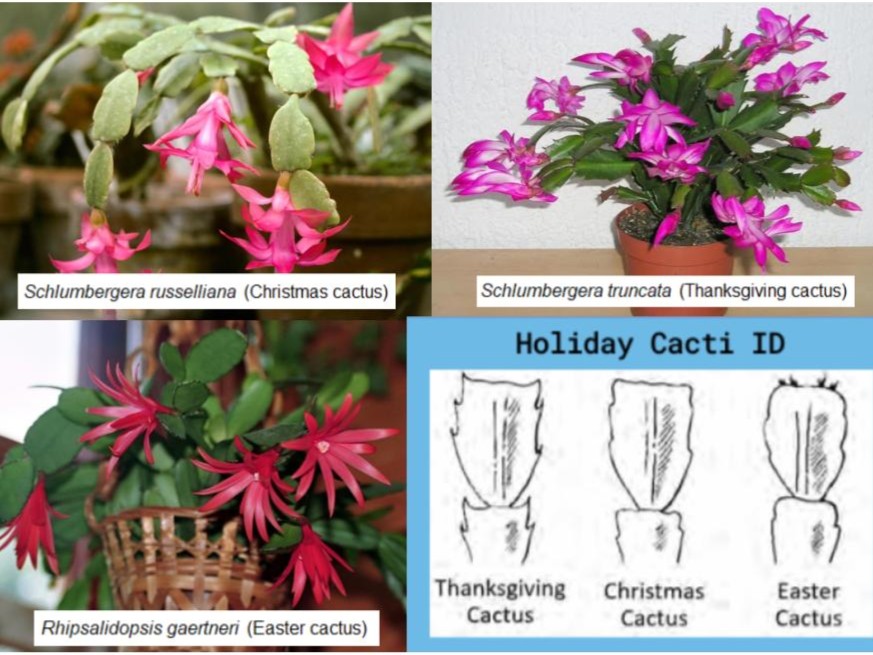
Schlumbergera
Common Names: Christmas Cactus, Crab Cactus, Thanksgiving Cactus, Holiday Cactus
Previously known as: Epiphyllanthus, Pseudozygocactus, Zygocactus
The holiday cactus is a genus of succulent plants in the cactus family (Cactaceae) that are native to Southeast Brazil and are technically epiphytes that grows in humid rainforests—a very different habitat from the “typical” cacti of Mexico and the Desert Southwest. This genus includes the Christmas and Thanksgiving cactus. It has fleshy stems, showy flowers and grows well as a houseplant, preferring moisture but adapting to a variety of home environments. One plant can live for over a hundred years, so a well-cared for specimen will brighten your living space for decades to come. The genus name, Schlumbergera, honors the Belgian horticulturist, Frederick Schlumberger.
This genus of cactus thrives in bright, indirect sunlight, but they are intolerant to direct sun. Periods of lower light in the fall will encourage winter blooms. They are day-length sensitive, initiating flowers as day lengths and seasons change. Consequently, they bloom more reliably when grown away from artificial light sources. The soil should be moist, well drained potting mix including sand or perlite to encourage adequate drainage. Water the plant about every 1 to 2 weeks or when the soil is nearly dried out. They also benefit from high humidity and prefer temperatures between 70- and 80-degrees Fahrenheit during their growing season. The secret to good flower production is bright light, night temperatures between 55 to 65 degrees Fahrenheit, and uninterrupted nights of at least 13 hours from mid-September until mid-November. If your plant does not flower, chances are, it is getting artificial light when it needs total darkness. They may be propagated by stem or root cuttings.
This genus of cacti has an upright, pendulous, or trailing habit. They have connecting green, glossy, flat, leaf-like pads or stem segments that are spineless. They are also serrated on each side with clusters of soft bristles at the end of each segment. The flowers are 3 inches long, tubular-shaped, and are available in a variety of colors including shades of red, pink, or white. They typically bloom in November and December. The flowers may also produce fleshy fruits.
Cultivated Schlumbergera cacti are often confused with species now placed in the genus Rhipsalidopsis, and species have been moved back and forth between the two genera. The Easter cactus is now called Rhipsalidopsis gaertneri. The taxonomy of these cacti is still somewhat unsettled, and the species may be listed under synonymous names in catalogs, books and websites.
The plants in this genus are low-maintenance and are the perfect indoor ornamental during the holiday season. The showy, vibrant flowers will add color to your home when planted in containers or hanging baskets.
‘Senecio’ by Tom Glavich
Senecio is a genus in the Compositae family a distinction that it shares with such common plants as sunflowers, Asters, and dandelions. Senecio is a very large and cosmopolitan genus, with species in most of the tropical and sub-tropical regions of the world.
All of the Compositae are distinguished by a flowerhead that appears to be a single large flower, but is really a cluster of many smaller flowers (florets) protected (and advertised to passing pollinators) by colorful bracts. The flowers of Senecio show obvious resemblance to dandelions and sunflowers. The seeds are held in loose clusters and scattered by the wind, just as with dandelions.
Senecio are generally easy to grow, requiring only modest attention to growing periods, and tolerant of some out of season watering. Most species are winter growers, losing their leaves in the heat of summer and leafing out again in early autumn.
Seed is occasionally available and germinates readily. It’s best planted in mid-autumn with maximum growth and development of water storage tissue possible before the first summer. Propagation from cuttings is also easy. Production of a typical caudex for species with long, thin branches is best done by burying and rooting a branch while still attached to the mother plant.
Show-worthy Senecios:
Senecio cedrorum is a species from Madagascar. It has vertical leaves, looking somewhat like the pads of a small Opuntia. The leaves are a glabrous blue, with darker green veins.
Senecio fulgens is from South Africa, near Durban. It has sprawling stems.
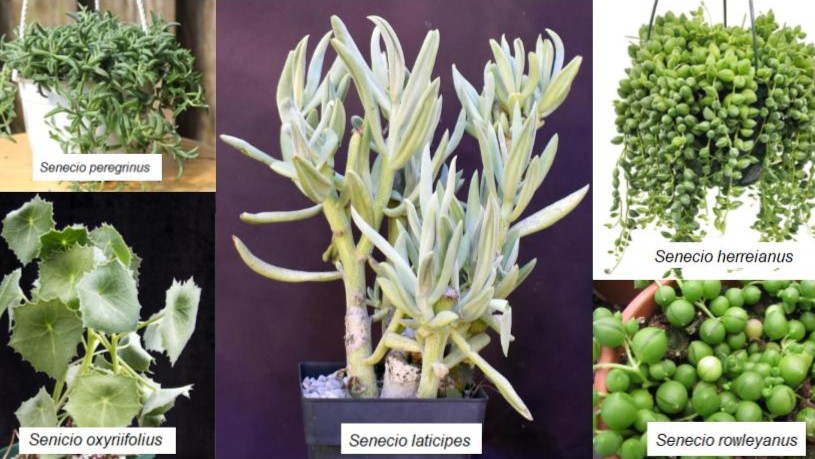
Senecio laticipes, shown below, is an easily grown species with thick succulent stems. It is easily propagated.
Senecio rowleyanus has the common name, “String of Pearls”, and is a well-known house plant, The leaves are globose, hanging on long prostrate stems. It’s often used as a hanging plant.
Senecio saginata is one of several Senecio that were once in the genus Kleinia, which has since been absorbed into Senecio. This species shows convergent evolution, with a body form similar to some of the cylindrical Opuntia. The body is a medium green, with darker green patterns that look as if they were spines drawn on with ink. Senecio saginata is native to Oman. Most of the similar species (S. pendulus, S. desflersii) are native to Western Africa and the Arabian Peninsula.
Senecio scaposus, is from Cape Province, South Africa, and has long cylindrical leaves, with patterned patches of a waxy light blue on a light green background.
Senecio sempervivus, has leaves that resemble a Sempervivum, as its name implies, but the stems holding the Sempervivum-like leaves come from a knobby white caudex. A red shaving brush flower rises above the leaves on a long stem.Senecio tropaeolifolius quickly forms a medium sized caudex (really a rhizome, or fleshy root). The vine-like stems can be kept trimmed back to show the caudex. It has interesting pentagonal leaves, with sharp corners. It’s one of the most sculptural of all the Senecios.

 Gates Cactus and Succulent Society