
Cactus: Opuntiadeae
Succulent: Stapelia, Huernia
**Remember: You must be up-to-date on your membership dues to be eligible to compete in the monthly mini-show. See Jeff prior to submitting your plants to ensure you are current on membership.
Opuntiadeae by Tom Glavich
The Cactus family is divided into a number of subfamilies. The Opuntioideae is one of these subfamilies. The Opuntioideae covers the largest geographical range of any of the subfamilies, stretching from Southern Argentina to Canada, and covers all of the Caribbean islands and Pacific Islands from the Galapagos to the Catalinas. It is naturalized on every continent except Antarctica. It is a pest and a noxious weed in many places, and is displacing native vegetation in parts of Africa, Asia, Madagascar and Australia.

The first plants that come to mind when one thinks of Opuntia are the flat pads, seen everywhere, or the spiny cylindrical Cholla common to the local hillsides and deserts. The Opuntioideae family offers much more, and some unusual as well as common forms are described below.
Propagation of all Opuntias is most easily accomplished by cuttings. All cuttings root easily. Seed propagation requires patience, with seed scarification and sometimes artificial wintering by keeping the seed damp and cold in the refrigerator required. Seed germination can be erratic, with seeds from the same plant sometimes germinating in days, and sometimes not for months or years.
Handling of Opuntias is somewhat of a problem. They are notorious for their well placed sharp spines, and nearly invisible glochids. Handling with steel tools is the best bet. Gloves get covered with glochids, which invariably end up in your hands when the gloves come off. Glochids can often be removed by washing with a strong hose stream. Plucking with tweezers is effective and brushing works sometimes. Duct tape is a help, and as a last resort, so is rubber cement.
All Ficus can be easily propagated from seed or cuttings. Seed is best planted in late spring, when the weather is guaranteed to be warm. Growth is generally fast, and repotting is necessary soon after germination. Cuttings can be taken any time when in active growth, and simply stuck in damp, loose potting soil. If a cutting is taken with several leaves, best results will be obtained if all the leaves except one or two of the smallest are removed. Rooting is generally rapid.
There are several South African and Asian pachycaul Ficus that can also be found, most often as seed. Some of these lose their pachycaul or caudiciform habit as they mature but are clearly succulent plants when young. They are all worth trying and experimenting with. They are almost all receptive to hard pruning to make the caudex develop.
Ficus abutilifolia forms a caudex when less than an inch across. The caudex forms almost immediately when grown from seed.
Ficus arnottiana from the deserts of NW India resembles Ficus palmeri.Ficus glumosa is native to Natal, Swaziland and Namibia eventually becomes a large tree. It is common to many warm areas of Asia with prolonged annual periods without rain.
Opuntia, the most widespread of the genera, has a number of great species for the collector.
Opuntia basilaris, a local native, can hold its own with any of the more exotic plants listed below.
Opuntia burrageana, native to Baja California forms low mounds of sharply spined cylindrical stems. It’s beautiful in the field, but a hazard to the careless hiker.
Opuntia compressa grows as a native plant as far north as the Pine Barrens of New Jersey. It’s a native of well drained soils of the Eastern United States.
Opuntia erinacea, another California native gets long white spines that resemble hair.
Opuntia microdasys, particularly the very common small white form, is really a spectacular plant. If this were hard to grow, it would be in every collection and in every show.
Opuntia pachypus, a native of Peru, is the only columnar Opuntia. It’s rarely seen, and hard to grow.
Opuntia ramosissima gets long slender shoots, each about the width of a pencil, covered with wicked spines.
Opuntia violacea v. santa rita, is gets a beautiful purple, offset with black spines.
Pereskiopsis looks like a Pereskia, and more like a tropical shrub than a cactus, with long leaves and thick stems. It’s native to the tropical regions of Southern Mexico and Guatemala; there are about 12 species.
Pereskiopsis porterii is often used as a grafting stock for small seedlings. It is not cold tolerant, and tends to get scabby and lose its leaves in the winter in Southern California. Pterocactus is an Argentine geophytic genus, with deciduous brown stems coming from a convoluted and interesting tuberous root. The stems are easily rooted, which is fortunate, since they are even more easily detached, whenever the plant is moved. The roots grow quickly, and can be raised every year or two to make a spectacular plant.
Pterocactus tuberosa is the most commonly seen species, but others have recently become available.
Stapelia and Huernia by Tom Glavich
The two genera for this month are members of the Asclepiadaceae or Milkweed Family, a large family of succulent and non-succulent plants.
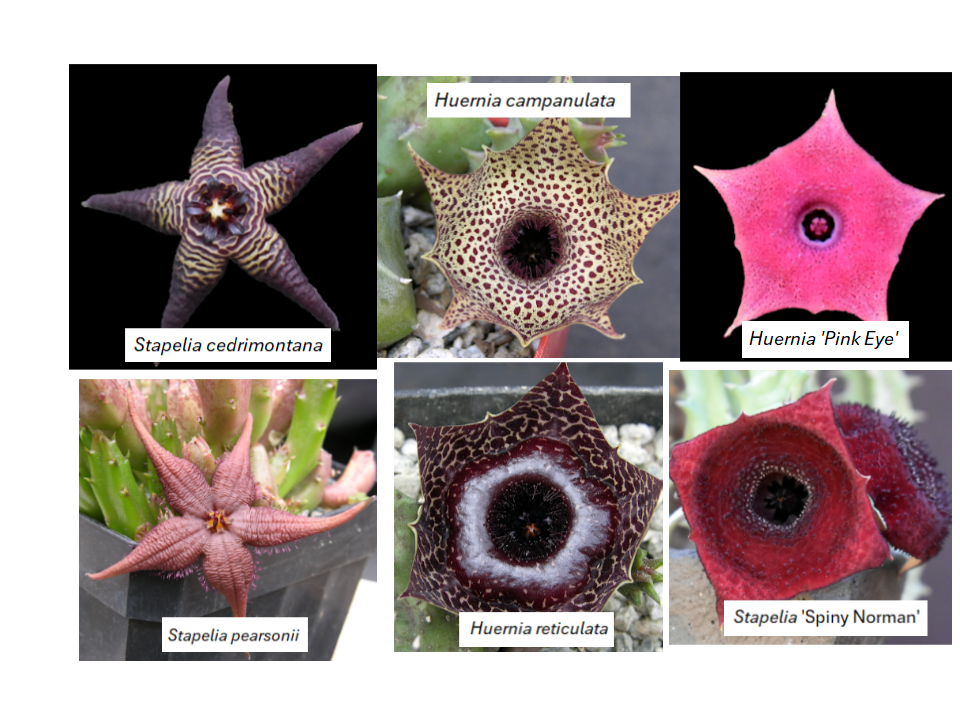
Huernia, and Stapelia are grown for their spectacular flowers. They generally have a foul odor (although often very faint), and many have small hairs that move in the slightest breeze simulating the hairs that grow on rotting meat. They attract and are pollinated by flies and gnats.
Stapelia and Huernia by Tom Glavich

 Gates Cactus and Succulent Society