
Cactus: Echinopsis
Succulent: Stem Succulent Euphorbias
**Remember: You must be up-to-date on your membership dues to be eligible to compete in the monthly mini-show. See Jeff prior to submitting your plants to ensure you are current on membership.
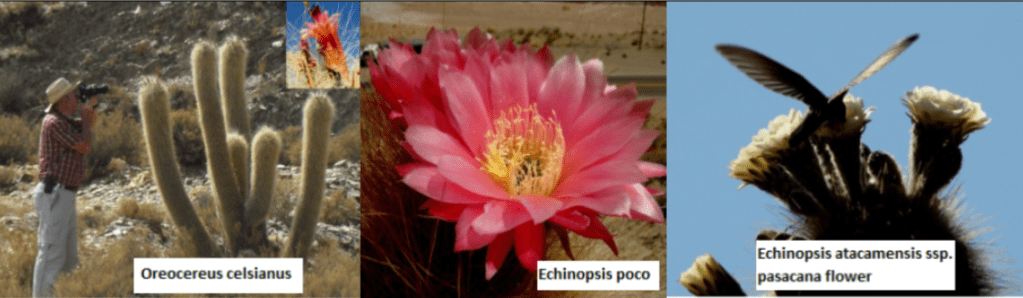
Echinopsis by Buck Hemenway
The genus Echinopsis is one that is not well understood. All of the publishing botanists admit that there is confusion about this very large genus. The plants are all endemic to South America and grow primarily in subtropical to tropical locations from low elevations to over 12,000 ft.
Using the New Cactus Lexicon as a guide, the genus now includes Echinopsis, Trichocereus, Lobivia, Pseudolobivia, and Soehrensia among others. There are 128 species recognized in this genus.
The plants range in size from the small ball-like clumping forms of Echinopsis eyriesii to the giant tree-like forms of E. terscheckii and atacamensis. They are usually branching, forming shrubs of varying stature. They bloom subapically, meaning lower on the branch than the very tip, to mid branch.
The blooms are, for the most part, funnel-form, and usually have overlapping scales on the flower tube that are normally tipped with hair-like bristles. They are among the most dramatic of all flowers and can range in color from pure white, to brilliant yellow to hot, bright red. The size of the flowers can range to 12” long and more than 6” wide at the mouth.
The smaller forms have been hybridized for years to produce new flower colors and we see the results in the offerings from the Huntington Library and Botanical Gardens, which have been hybridized by Bob Schick from plants originally grown at the Paramount Nursery in the mid-1900’s.
They are very easy to grow in our Inland climate and do very well in the ground in well drained conditions and as well as in pots. They tend to be pest-free, but care should be taken to make certain that no mealy bugs infest these plants. A few of the smaller varieties need protection from the coldest nights, but for the most part, they will stand full sun. They do well in our winter rainfall climate and like some occasional summer watering as well. We always need to make sure that the soil is fairly well dried out before watering.
They are easy to propagate. Any branch on any size plant can be removed (best at the joining place), allowed to callous for a few weeks, and rooted.
Stem Succulent Euphorbias by Tom Glavich (2024)
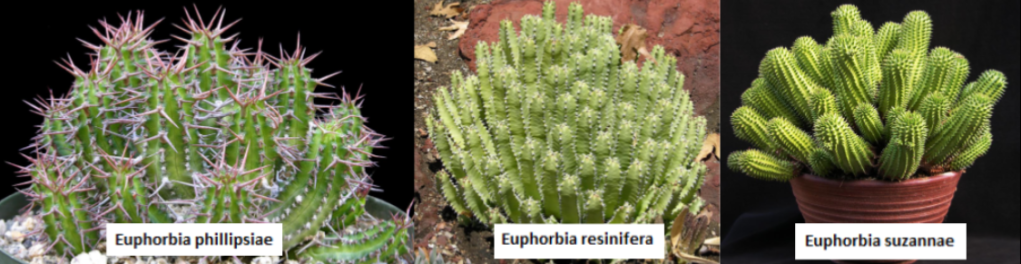
Stem succulent Euphorbias are exactly what they seem. These are Euphorbias in which the main food and water storage organ is the stem. They are a perfect example of convergent evolution often resembling cacti in almost every aspect except flowers. They are not caudiform or medusoid species even though these may have green stems.
Stem succulent Euphorbias can be found throughout Africa, in the Mediterranean, on Madagascar and the other offshore islands, in India, on the Canary Islands, in South America, and even in Mexico. Some have persistent leaves, some don’t. Those from tropical climates (Uganda, Madagascar, Kenya, Sudan, Ethiopia, Yemen) tend to be frost sensitive. Those from Mediterranean climates (South Africa, Canary Islands, Mexico) tend to be tolerant of some frost. There are exceptions in both cases.
In general, all of these are easy to grow. Good, fast draining potting mixes, protection from excessive winter water and cold, are really all they ask. They benefit from relatively frequent repotting, and fairly frequent applications of fertilizer when they are growing.
Seed of most Euphorbia is hard to come by. The seed is short lived,and should be planted as soon as available. Once germinated the seedlings are similar to cacti seeds, growing slowly at first, and then accelerating in the second and third years. A more common method of propagation is vegetative propagation. Cuttings can be taken when in active growth. The latex is often an irritant, and sometimes a severe one, so care must be taken to keep it of your skin and clothes. Eye protection should be used when cutting Euphorbias.
Euphorbias will bleed a milky latex when cut. This can be stopped by spraying with cold water. The cuttings are then left to dry for a few days, replanted, and watered lightly until roots form and new growth starts. For large cuttings new growth may not appear for six months.
Some Stem Succulent Euphorbias (there are many more): E. bupleurifolia, E. confinalis, E. fasiculata, E. genoudiana, E. gymnocalycioides, E. horrida, E. milli, E. millottii, E. obesa, E. phillipsioides, E. rossii, E. stellaspina, E. suzannae, E. symmetrica, and E. valida.

 Gates Cactus and Succulent Society