
Cactus: White Spined Mammillaria Succulent: Aeonium, Sedum, Sempervivum
Succulent: Aeonium, Sedum, Sempervivum
**Remember: You must be up-to-date on your membership dues to be eligible to compete in the monthly mini-show. See Jeff prior to submitting your plants to ensure you are current on membership.
Mammillaria with White Spines by Buck Hemenway

We all have at least a few mammillarias in our collections. They are among the easiest of all succulent plants to grow and among the hardest to kill. Many mammillarias follow collectors from their earliest days of collecting throughout their hobby career, becoming large and fantastic with age. There’s nothing like a 30 year old Mammillaria plumosa on a show table with 50 or more heads filling up a 16” bowl.
From my earliest beginnings as a “grower” and “collector” of cacti and succulents, I’ve been made aware that some of these beautiful plants are more tolerant of our inland conditions than others. In particular, White-spined Mammillaria are a group of plants that love the sun and heat that our climate produces each summer. They are also able to tolerate more garden water than many of the other Mammilaria. M. parkinsonii, M. geminispina, and their close relatives just soak up the heat and ask for more.
Not all are quite as easy. M. plumosa has a habit of losing its roots when the weather is very hot and or very cold. They can be tricky then. The worst thing is to look at one and decide that it needs more water without checking the roots. They will rot very quickly if their roots are not growing. In fact a very healthy plant will have a tiny root ball.
Mammillaria pests need watching for. The plants are subject to mealy bug (both spine and root mealies) and spider mite in particular. The white tufts of “hair” between aureoles can look just like mealy bugs, so keep on the lookout for the bugs and kill them in your own favorite way. Spider mite is only an issue in closed in environments, but can be a big problem if not cleaned up at first notice.
You will find mammillarias blooming all 12 months of the year. Most have small flowers that range in color from white to yellow to red. The small fruit (seed pods) are quite decorative and have the plus of being very sweet when ripe and tasty.
Culture is pretty simple on most species. They are very happy to be left alone. They only need water when the soil is pretty dry. So if one waters only when the soil is dry, they can expect great results growing Mammillaria.
Aeoniums, Sempervivums, and Sedums
References: The New Cactus Lexicon; Tom Glavich; Illustrated Handbook of Succulents
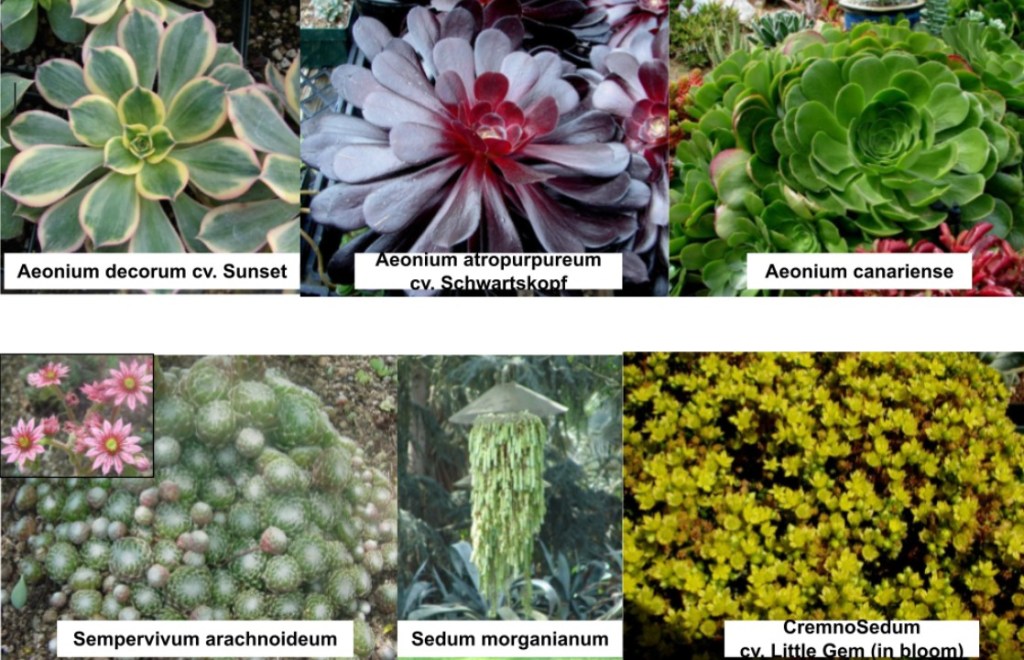
These are a group of related plants in the family Crassulaceae. While they share a number of characteristics, they grow in very different climactic areas (Biomes). Aeoniums originate in the Canary Islands in the tropical Atlantic Ocean. Sempervivums grow in the mountains of Europe at high altitude in obviously very cold winter conditions. Sedums grow all over the globe in relatively dry mini climates. The most species occur in North America from Canada to Central America with 120 of 170 North American species endemic to Mexico. Actually, very few of them are perfectly adapted to inland Southern California weather. We need to take precautions so they can show their beauty in the growing season.
AEONIUM
These are subtropical, island natives. Mild, consistent, humid weather is their preference. Most of them will show stress in cold (below freezing) and hot (above 95 deg F) weather, The biggest, most beautiful heads of Aeonium cv. Cyclops will shrink from 15 or more inches across to less than 5” in the heat of the summer. By mid December, they are back to their full beauty and will last save a very cold spell.
All Aeoniums bloom. Most produce a very large terminal inflorescence, covered with small cream to yellow flowers. The bloom indicates the mother head will no longer exist, but normally, there will be enough offsets surrounding the mother head to cover the old stock. Most Aeoniums grow into shrubs up to 3′ or so tall and as wide. The beautiful colors of the leaves provide dramatic accents to any garden. They are relatively tolerant of more water than most succulents and will thrive along with more thirsty plants as long as they are well drained. Fabulous hybrids have been developed in Southern California over the last 50 years and are available in specialty succulent sales.
They propagate easily from cuttings and broken off branches from Santa Ana winds. No special care is needed… just stick the newly created branch in soil and it will grow. Seed is almost never used. Some of the varieties will form small plantlets between the flowers on the inflorescence and they are all viable plants.
Watch for mealy bugs. Use your best mealy bug killer when you see evidence, and kill the ants that are carrying the eggs and larvae to your plant.
SEMPERVIVUM
Includes all with names of Sempervivum and Jovibarba. These plants, also known as “Hen & Chicks” are alpine in origin in Central and Southern Europe. About 40 species are currently recognized and there are hundreds of cultivars in existence. In fact, they hybridize easily in nature which makes their names suspect at the best. The very nature of their origin makes them somewhat difficult to grow in inland Southern California. They absolutely cannot stand our summer heat and sun. We are successful with some of the varieties in the ground where they get, at most, morning sun. They do fairly well under 50% shade cloth.
As mealy bugs are a problem, constant vigilance is necessary. They grow fine in well drained coarse soil, but cannot take much water in the summer when they are dormant without rotting. We are never cold enough in winter to cause any concern.
The very name “Hen & Chicks” gives a clue to propagation. Offsets are easily taken from the mother plant and rooted during their growing period which is any time after the daily high temperature goes below 90 degrees. They will offset and continue to grow, forming mat-like clumps more than 3’ across in the ground or filling virtually any pot.
Keep an eye out for attractive hybrids and cultivars, but be aware that they won’t like it in the summer. The blooms are on a terminal inflorescence and are some of the most attractive small flowers of all succulents.
SEDUM
This term includes Cremnosedum, and other closely related genera. A the largest genus in the Crassulaceae family with 420 recognized species, this genus gives every succulent grower a chance to shine. Most of the genus have fleshy stems without tubers, and are hardy to specific regions based on their origin. In other words, some of them are hardy well below freezing while others will freeze and die off to mush at the first hint of frost. There are some spectacular plants with great showy inflorescences full of small white to yellow flowers. From the massive Burro’s Tail at Lotus Land to the very attractive Cremnosedum cv. Little Gem, these plants add texture and year round color to in-ground plantings as well as containers on the patio.

 Gates Cactus and Succulent Society