
Biography: Wendell S. (Woody) Minnich
Woody, as he is commonly known, grew up in the Mojave Desert and has had an attraction to desert plants and animals since the early 1950’s. He has been involved with the cactus and succulent world for over 52 years, as a grower, field explorer, club and organization leader, writer, photographer, lecturer and presenter.
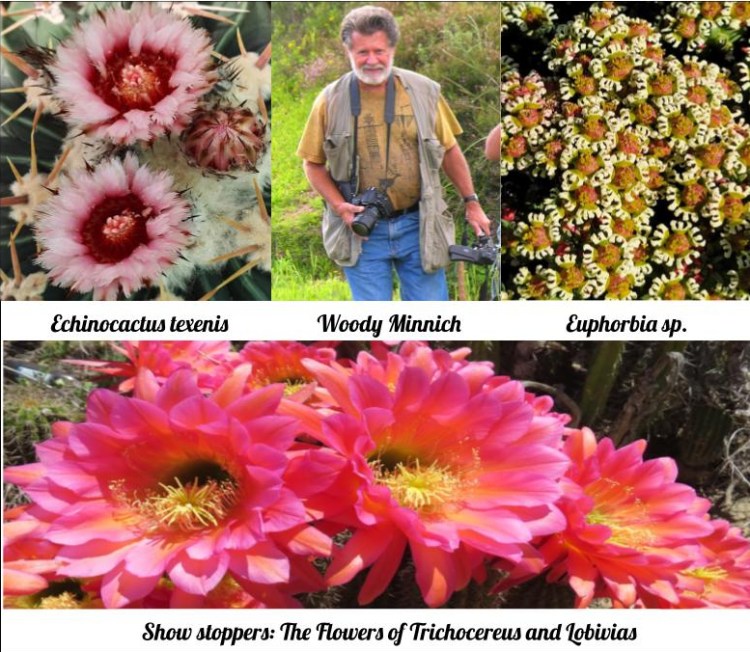
Having been a speaker all over the world, Woody is most often associated with giving presentations on his field work from the wild places he has traveled. This talk will be featuring his encounters with many beautiful flowering cacti and other succulents, as well as his observations of their pollinators.
He has published numerous articles and his photography is featured in many books including; “The Copiapoa” by Schulz, “The Mammillaria Handbook” by Pilbeam, “The Cactus Lexicon” By Hunt and Charles, as well as many others. As of November 2017, he is featured as the primary photographer in the sold out book “The Xerophile.” This book specializes in what the authors call, The Obsessed Field workers from around the world.
Woody and his wife, Kathy, live in Cedar Grove, New Mexico. He is a retired secondary school teacher of 32 years where he taught Graphics, Art and Architecture.
In the cactus and succulent hobby, Woody is recognized for his high energy and creative spirit. As an educator, he has become an important part of the hobby and thus is an honorary life member of thirteen C&S societies across the country. Woody has also served on the CSSA board and in many leadership positions with numerous other societies. He is a co-creator, and currently the president, of the Santa Fe Cactus and Succulent Club. With 52 years in the hobby and 64 years in the field (old fart), he has many experiences to share and thousands of photos to show. If you’re like Woody, put your glasses on and turn up your hearing aids, and we’ll all have some fun.
Program Description: Flowering Cacti and Succulents and their Pollinators
The flowers of the world are amazing! Within their incredible diversity of shapes, colors and floral parts, the cacti and other succulents really hold their own. With taxonomy being the formal method for separating and naming genera and species, the flowers, fruit and seeds are their most important parts for showing their relationships. We will not only look at these floral relationships but we will observe the many different pollinating vectors that are so perfectly matched to all of their unique reproductive mechanisms.
The numerous genera included within the Cactaceae are fascinating and different, yet they are recognizably related with their floral characteristics. They all have classic stigma lobs, the female parts, and very regular pollen producing parts called anthers, the male parts. The great majority have corollas with moderate to long and generally conspicuously colored petals. Also, what makes a cactus a cactus, is they all have an exposed ovary at the base of the flower. This ovary, once it has been fertilized pollinated, generally swells up and often becomes a large and very succulent fruit.
The Cactaceae includes many genera including epiphytes, geophytes and globular or bush or tree-like terrestrials. We will see many of the flowers and pollinators of the following cactus genera: Acanthocalycium, Ariocarpus, Astrophytum, Aztekium, Blossfeldia, Carnegiea, Cereus, Cleistocactus, Copiapoa, Coryphantha, Discocactus, Echinocactus, Echinocereus, Echinopsis, Epithelantha, Epiphyllum, Eriosyce, Escobaria, Ferocactus, Frailea, Gymnocalycium, Lobivia, Lophophora, Mammillaria, Matucana, Melocactus, Neochilenia, Neoporteria, Notocactus, Obregonia, Opuntia, Parodia, Pediocactus, Rebutia, Schlumbergera, Sclerocactus, Strombocactus, Sulcorebutia, Tephrocactus, Trichocereus, Uebelmannia, and Zygocactus. There are many other genera of the Cactaceae not listed here.
The Succulents, other than the Cactaceae, include many very different and extremely unique genera. Some of the succulents have very tiny flowers often pollinated by special methods from the smallest of creatures to the winds and moisture of their native habitat. There are also other succulents with giant, or fragrant, or especially shaped flower forms, that require exciting exact pollinators. Recognizing the flowers of each genus is generally easy, but often their variations can be extreme. Some of the genera we will encounter will include: Agave, Aloe, Bromeliads, Bursera, Cotyledon, Crassula, Cyphostemma, Dudleya, Echeveria, Euphorbia, Fouquieria, Gasteria, Haworthia, Hoodia, Huernia, Pachyphytum, Pachypodium, Sedum, Stapelia, Tylecodon, Yucca, and many, many more.
Come join me to appreciate these beautiful, unique and magnificent flowers and their interesting pollinators. Some of these photos were taken over the last 50+ years and are from my many visits to wild habitats around world.

 Gates Cactus and Succulent Society